Coach website examples: what good independent coach pages have in common
Examples and patterns for independent coach websites: clear positioning, specific services, proof, blog posts, reviews, and a direct request flow.
Good coach websites are specific
The strongest coach websites do not try to look big. They make the practice easy to judge. A visitor can tell who the coach helps, what the work looks like, what proof exists, and how to ask for the next step.
Specific does not mean narrow forever. It means the first screen and service sections make a clear promise to a real audience. A coach can still offer different paths, but each path should be easy to compare.
Patterns worth copying
- A headline that names the athlete and outcome.
- Service cards with format, cadence, and price context.
- A bio that explains judgment, not only credentials.
- Testimonials that mention specific change.
- One request CTA repeated at natural decision points.
What every example needs to prove
A coach website example is useful only if it shows the decision points a real prospect cares about. Pretty layouts help, but trust comes from clear positioning, concrete services, proof, photos, and a low-friction request path.
- Who the coach helps and who the offer is not for.
- What the first step looks like.
- How coaching is delivered: online, local, group, one-to-one, or hybrid.
- What proof supports the coach's judgment.
- What the prospect can read, watch, or check before sending a request.
- How the coach handles payment and scheduling after fit is confirmed.
Examples by coaching type
- A running coach can lead with race goal, injury history, and plan cadence.
- A cycling coach can lead with event preparation, training rhythm, and weekly constraints.
- A strength coach can lead with current capacity, progression style, and who the service is not for.
- A swim or triathlon coach can lead with technique, location, and seasonal goals.
Endurance coach
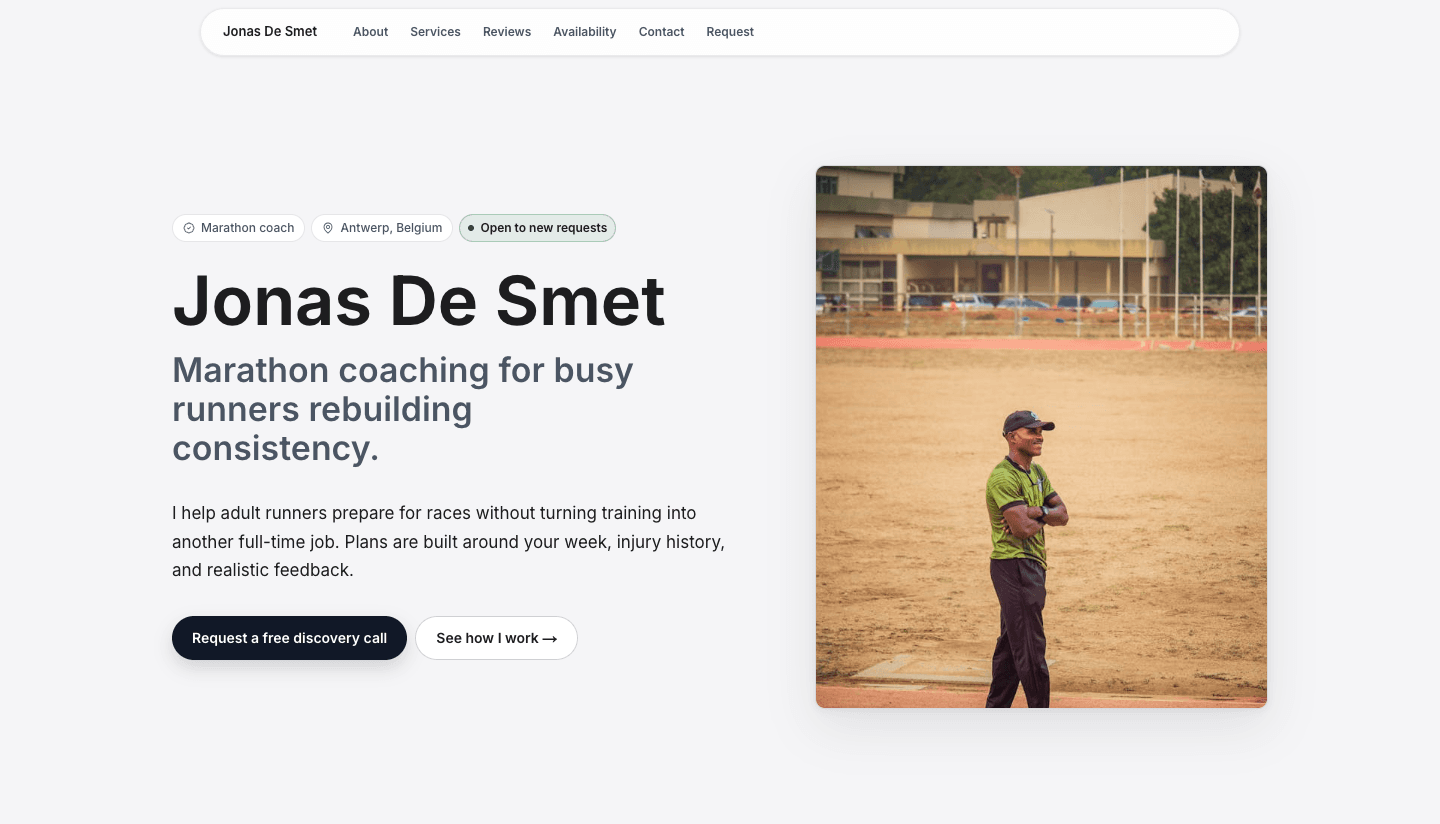
Jonas De Smet, marathon and return-to-running coach
A local example profile rendered with the real Coloseos public coach page UI.
- Hero: portrait at a track, city/service area, and one request CTA.
- Services: 12-week race block, return-to-running block, one-off race plan review.
- Proof: federation credential, independent coaching experience, and two specific testimonials.
- SEO angle: local marathon coaching, return-to-running support, and practical race preparation questions.
Cycling coach
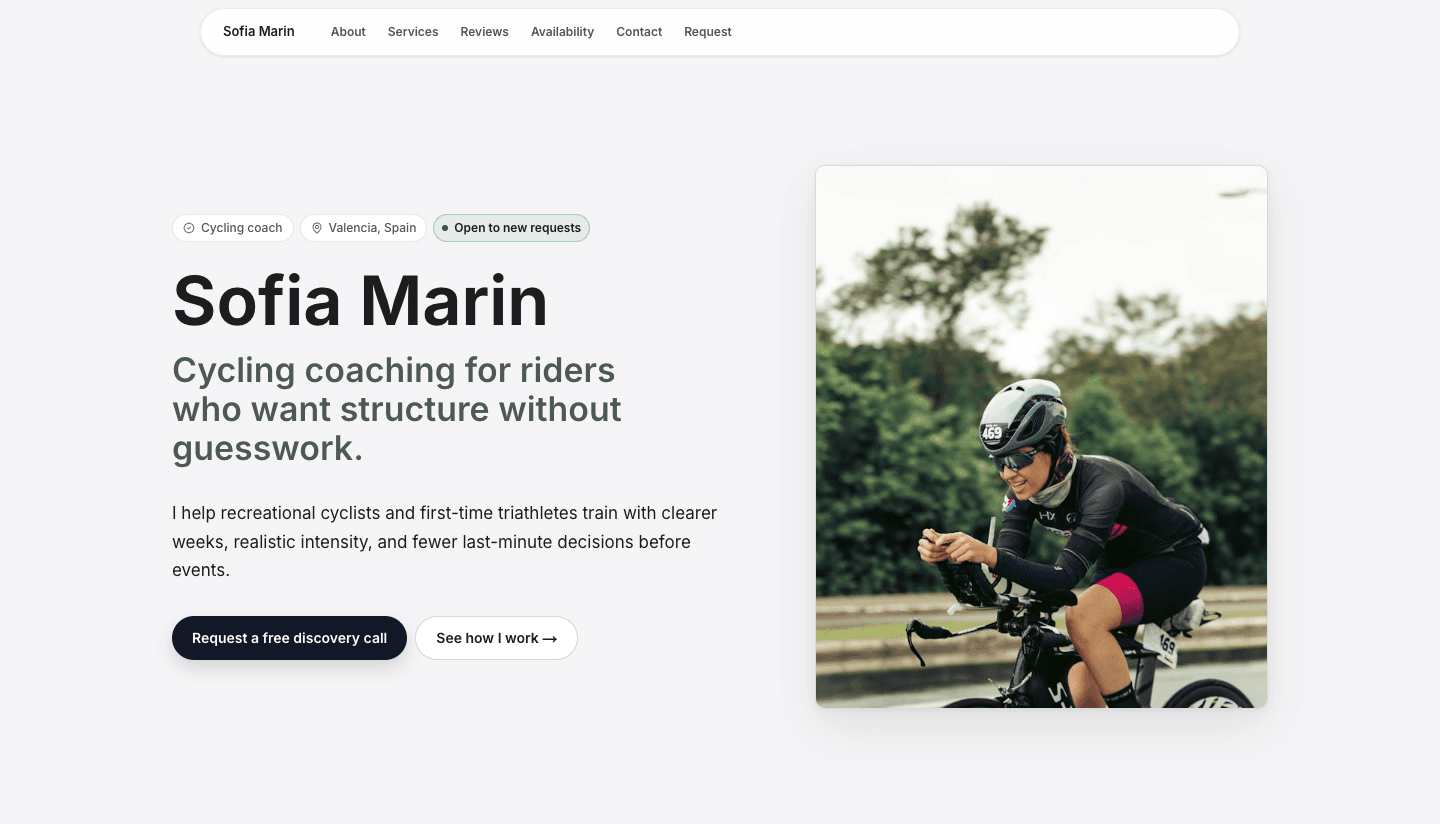
Sofia Marin, cycling and beginner triathlon coach
A local example profile using the actual coach page with a different discipline, service set, and accent palette.
- Hero: cycling coaching for riders who want structure without guesswork.
- Services: plan audit, 10-week event block, first-triathlon prep.
- Proof: UCI Academy certification, club experience, and specific rider testimonials.
- SEO angle: cycling coach, beginner triathlon preparation, event block, and training plan audit.
Strength coach
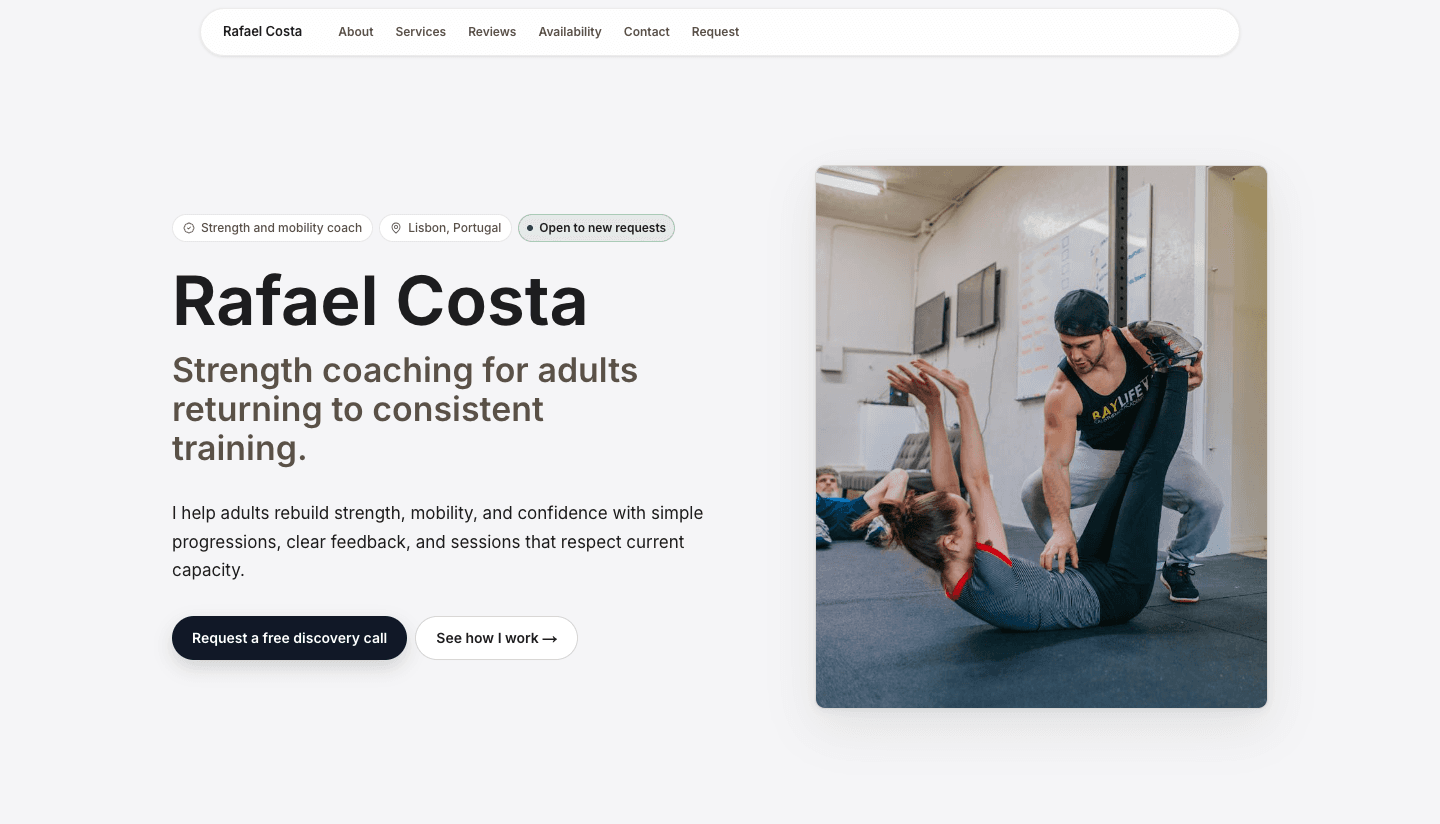
Rafael Costa, strength and mobility coach
A local example profile showing how a studio-based coaching offer can use the same Coloseos structure.
- Hero: strength coaching for adults returning to consistent training.
- Services: strength assessment, 8-week block, mobility reset.
- Proof: education, certification, and return-to-training testimonials.
- SEO angle: beginner strength coaching, mobility coaching, and return-to-training support.
How to adapt these examples
The point is not to copy the names or exact services. The reusable pattern is the order of information. Start with fit, show the offer, show proof, answer objections, and repeat the request action at natural decision points.
If you coach locally
Lead with city, venue, and service area
A local coach should mention the real places where work happens: the track, gym, pool, studio, school, clinic, or neighborhood. Those details help both SEO and trust.
- Use local photos when possible.
- Mention events or clinics tied to real places.
- Link the Google Business Profile to the same public page.
If you coach online
Lead with method, cadence, and communication
Remote coaching needs more clarity about how the relationship works. Prospects want to know how often they get feedback, where plans live, and what happens between calls.
- Show the review rhythm and communication expectations.
- Explain what is asynchronous and what happens live.
- Use testimonials that mention clarity, follow-through, or accountability.
Common mistakes in coach website examples
- A hero headline that says 'unlock your potential' but names no audience.
- Beautiful photos with no service detail.
- Testimonials that sound impressive but do not say what changed.
- A booking button that implies instant purchase when the coach still needs to approve fit.
- No pricing context, even for fixed offers.
- No internal links from examples or articles back to the services page.
How Coloseos helps
Coloseos turns the same pattern into a public coach page: hero, services, programs, proof, blog posts, events, reviews, legal pages, and a direct request form.