Coaching website SEO basics: what matters before advanced tactics
SEO basics for coaches: clear pages, useful articles, local context, internal links, metadata, and proof that supports search intent.
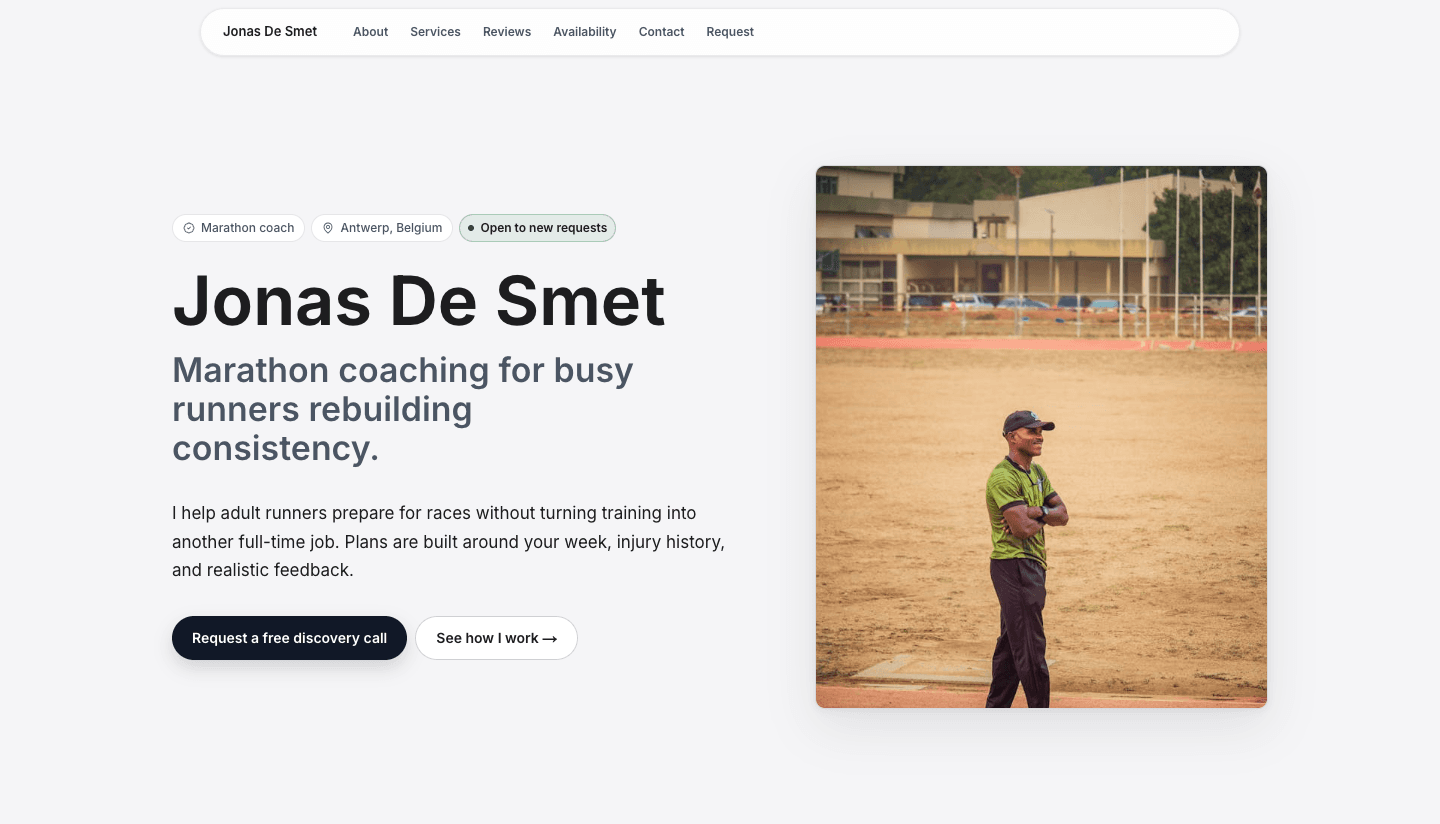
SEO starts with a page worth landing on
A coach can chase keywords forever, but search traffic only helps if the page builds trust. Start with a clear website, services, proof, blog posts, reviews, and a request flow.
Good SEO is not separate from good positioning. Google needs to understand the page, and the prospect needs to understand whether the coach is a fit. The same ingredients help both: useful copy, clear headings, crawlable links, local context, and specific proof.
The basics to get right
- One clear title and description for every public page.
- Service names written in the language prospects use.
- Local context when the coach works in a place or venue.
- Useful articles that answer real pre-session questions.
- Internal links between related guides, services, events, and proof.
Simple SEO map
One page should answer one real search intent
For a fictional cycling coach in Ghent, the homepage can target 'cycling coach in Ghent,' a service page can target 'beginner cycling coaching,' and a blog post can answer 'how to prepare for a first group ride.'
- Homepage: who the coach helps, location, proof, and request action.
- Service page: offer details, cadence, price context, and fit.
- Article: one useful answer that links back to the relevant service.
Map keywords to real pages
A coach website should not force one page to rank for everything. The homepage can target the main coaching practice, service pages can target specific offers, and blog posts can answer pre-session questions.
- Homepage: main discipline, audience, location or online format, and proof.
- Service page: a specific offer, price context, fit, cadence, and request action.
- Blog post: one question a prospect asks before choosing a coach.
- Event page: local clinic, workshop, open session, or seasonal offer.
- Review or proof section: testimonials, Google reviews, results, and credentials.
Technical basics that matter
Most independent coaches do not need advanced technical SEO. They do need pages that can be crawled, read on mobile, linked internally, and described clearly in search results.
- Use descriptive page titles that match the visible page topic.
- Write meta descriptions as short summaries for humans, not keyword lists.
- Make important links normal links so search engines and users can follow them.
- Keep important content available on mobile, not only on desktop.
- Use descriptive alt text for meaningful images.
- Publish real pages for services, articles, events, and legal content instead of hiding everything in images or PDFs.
Content that can rank and convert
SEO content for coaches should be useful before it is promotional. A good article answers a question, then points naturally to the relevant service. It should include examples, constraints, and practical next steps that a generic article would miss.
Good article idea
How many weeks before a first half marathon should I start training?
This can rank for a real question and lead into a running coach's race preparation service.
- Answer the question directly.
- Explain what changes for beginners, returning runners, and experienced runners.
- Link to the race preparation service and request form.
Weak article idea
The ultimate guide to success
This is too broad to match a specific search intent or support a clear coaching offer.
Avoid SEO theatre
Thin city pages, repeated keyword blocks, and generic AI articles do not help the coach build trust. Useful content should teach, clarify, or reduce risk for a real prospect.
Google's current guidance still rewards helpful, people-first pages more than keyword volume. Advanced tactics matter less than clear pages that can be crawled, understood, and trusted.
How to measure progress
SEO should be judged by useful visibility, not vanity publishing. A coach should watch whether relevant pages are being indexed, whether impressions grow for the right searches, and whether visitors send better-qualified requests.
- Search impressions for the main practice and service pages.
- Clicks to services, articles, Google profile, and request sections.
- Requests that mention a service, article, location, or review.
- Pages that attract traffic but do not lead to useful next steps.
- Articles that should be updated because the service, price, or location changed.
SEO mistakes coaches should avoid
- Publishing many generic AI-written posts that do not connect to real services.
- Using the same title and description on every page.
- Creating city pages for places the coach does not actually serve.
- Putting important service copy only inside images, PDFs, or social embeds.
- Forgetting internal links between articles, services, examples, and request sections.
- Ignoring mobile content because the desktop page looks good.
How Coloseos helps
Coloseos gives coaches crawlable public pages for Site, blog posts, programs, events, legal pages, and selected resources, with a direct path back to requests.