Local SEO for coaches: how to show where you work without doorway pages
A practical guide to local SEO for coaches: service areas, venues, photos, Google profiles, reviews, and honest local content.
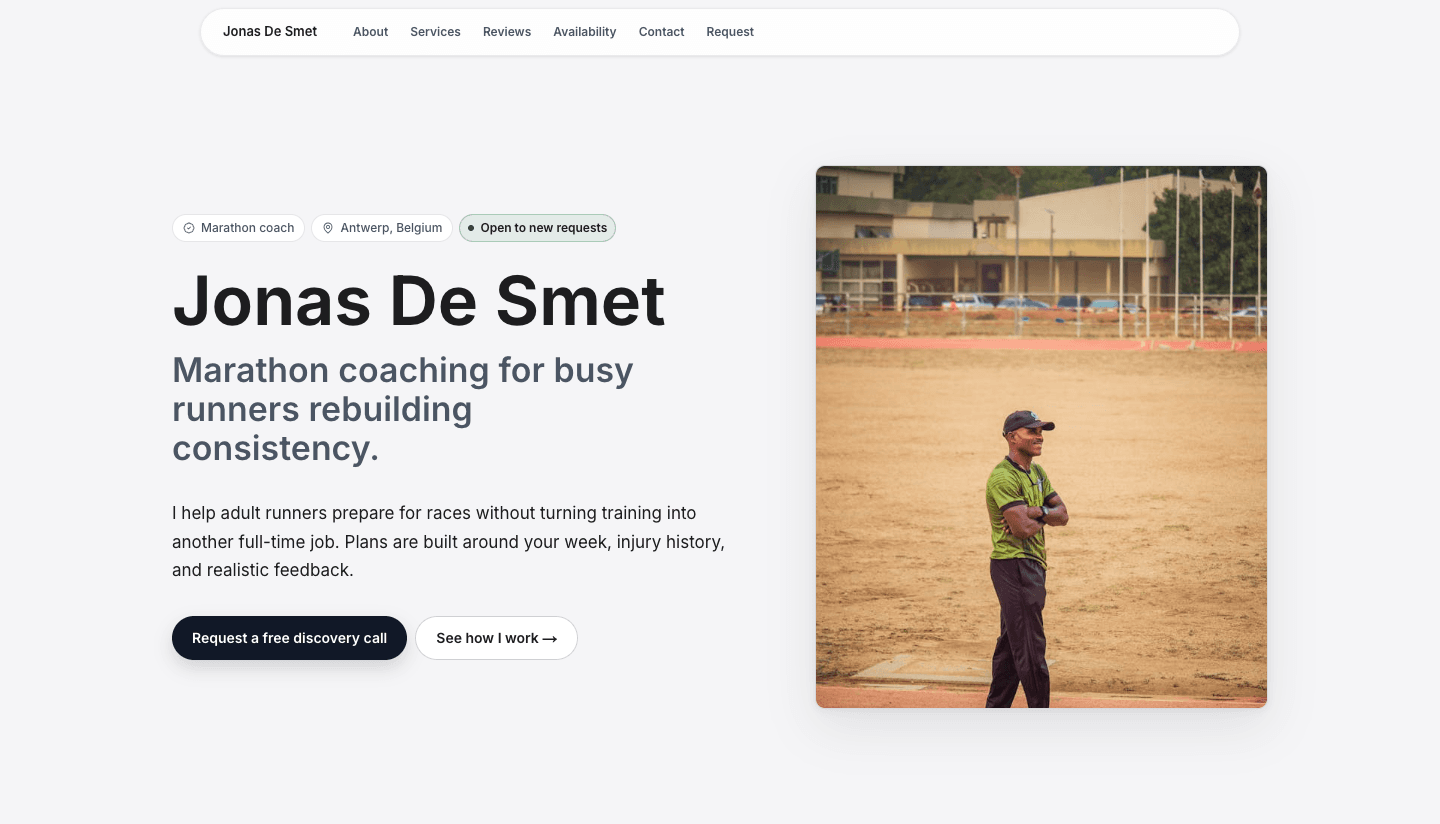
Local SEO should match real work
If a coach works in a city, venue, gym, clinic, field, studio, or service area, the website should say so plainly. The goal is not to manufacture local pages. The goal is to show real local relevance.
Local SEO works best when the page reflects where the coach actually meets people, runs sessions, hosts clinics, or serves clients. Searchers are not only looking for a nearby coach; they are trying to decide whether the coach is active, credible, and reachable in their area.
Signals that help
- A clear city or service area on the homepage.
- Venue names where the coach actually works.
- Events, clinics, or open sessions with local context.
- Photos from real sessions or places.
- Google reviews from real athletes.
Fictional local page
Rafael Costa, swim coach in Lisbon
Rafael should mention the pools and neighborhoods where he actually works, show session photos with permission, and publish a clinic page when he runs a local open session.
- Good local signal: 'Technique sessions at Complexo do Jamor and Saturday open-water clinics in Cascais.'
- Useful content: 'What to bring to your first open-water swim clinic in Cascais.'
- Avoid: separate duplicate pages for every nearby town with the same copy.
What to put on a local coach page
A local coach page should answer practical questions quickly. Where does the coaching happen? Who is it for? What services are available locally? What proof shows the coach is real in that place?
- City, neighborhood, venue, or service area written plainly.
- Services available in that location.
- Photos from real local settings when available.
- Google reviews or testimonials from local clients.
- Local events, clinics, workshops, races, venues, or partners.
- Clear request action with location or format context.
Service area pages should earn their existence
A separate service area page is useful only when it adds real local value. If a coach has different venues, schedules, partners, events, examples, or photos for a place, a separate page can make sense. If the page only swaps the city name, it should not exist.
Worth a local page
Beginner running coaching in Utrecht
This page can mention specific parks, local race preparation, session formats, neighborhood meeting points, and testimonials from local runners.
Not worth a local page
Running coach in every nearby town
If each page repeats the same copy and only changes the city, it looks like a doorway page and does not help the prospect.
What to avoid
- Dozens of identical city pages.
- Listing places the coach does not serve.
- Hiding the real location behind vague copy.
- Overwriting useful service copy with keyword stuffing.
Doorway-style copy
Running coach in Brussels, running coach in Leuven, running coach in Antwerp
If every page is almost identical and only swaps the city name, it is not helping the visitor. Build a local page only when the coach has real local proof, events, venues, photos, or service detail for that place.
Google Business Profile and website should agree
Local SEO is stronger when the Google Business Profile and website tell the same story. The business name, category, service area, photos, services, and contact path should match what a prospect sees after clicking through.
- Use a real business name, not a keyword-stuffed name.
- Link the profile to the most relevant coach website page.
- Keep service areas and in-person locations accurate.
- Use similar service names on Google and the website.
- Ask for honest reviews after real milestones and reply without private details.
Local content ideas for coaches
- What to expect at your first session in a specific venue.
- How to prepare for a local race, workshop, audition, recital, or interview season.
- A guide to choosing between local one-to-one coaching and remote coaching.
- A recap of a clinic or open session, with permissioned photos.
- A checklist for beginners using a local gym, pool, track, studio, or community space.
Local SEO checklist before publishing
- The page names the real city, venue, service area, or remote-local format.
- The services described are actually available there.
- Photos, reviews, events, or examples support the local claim.
- The Google Business Profile and website use consistent business details.
- The page has a clear request action for that location or format.
- Nearby-location pages are not duplicated versions of the same copy.
How Coloseos helps
Coloseos lets coaches publish locations, events, flyers, Google profile work, and blog posts from the same facts used on the public Site.